

DRONE REFORESTATION IN THE DAINTREE
Drone reforestation is a method of restoring cleared land by sowing seed from the air instead of planting every tree by hand. Rainforest Conservation Foundation was the first to bring scalable, broadacre land preparation to rainforest restoration, at George Mansford Reserve, and is now developing drone-assisted reforestation for the Daintree Rainforest and Wet Tropics region of Far North Queensland with an Australian restoration technology partner. Drones sow fast-growing cover across a site. The rainforest trees are then planted by hand beneath it.
Why the Pioneers Go in First
Rainforest seedlings will not establish in full sun on cleared land. They need cover. In traditional reforestation, that cover comes from planting thousands of trees close together and waiting.
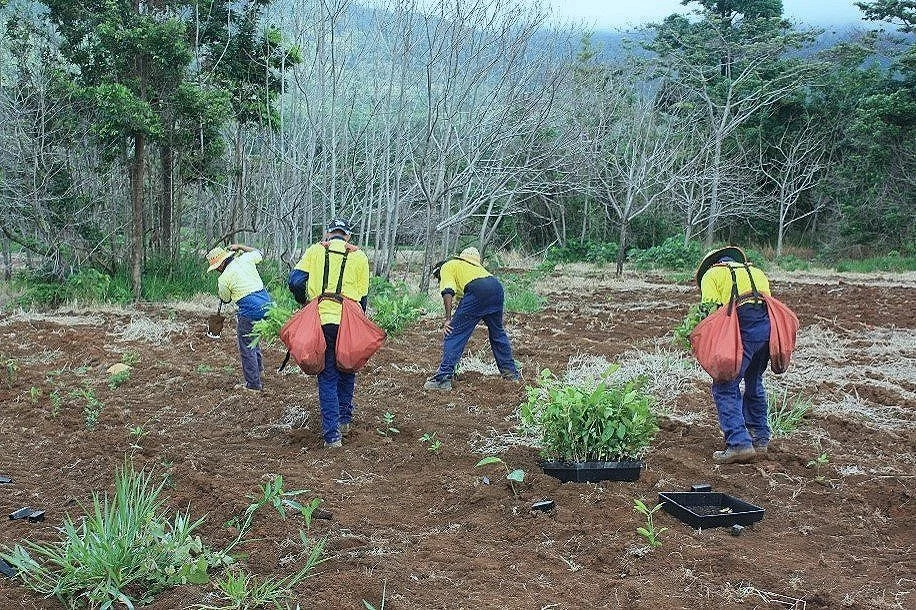
In this method, drones sow fast-growing pioneer species across the site. The pioneers grow quickly and create shade. Rainforest species are then hand planted in islands beneath them, grow up through the shelter the pioneers made, and in time overtake them. Rather than planting out every part of a site, the islands spread and the forest fills in from them.
Why the Daintree Needs a Faster Method
Around 54,000 hectares across the Wet Tropics need reforesting. More than 30,000 hectares of that sit along waterways that flow to the Great Barrier Reef, where restored forest improves the water quality the Reef depends on. Another 9,600 hectares sit on slopes steeper than 20 degrees, where getting people and seedlings onto the site is slow, expensive and sometimes unsafe.
Every reforestation organisation in the region combined replants in the order of 100 hectares a year. At that rate the job is never finished. A method that covers more ground in less time is the only way the arithmetic changes.
What Changes with Drones
Drone sowing covers in hours the ground that takes days to plant by hand, and it reaches country that people cannot work safely. The trade-off is that the rainforest canopy takes longer to close than on a densely hand-planted site, which is why the method asks more of the site preparation beforehand. The gain is ground covered, and that is the gain the Wet Tropics needs.
How a Project Runs
Find suitable land. Cleared country that can carry a forest again and adds to existing nature corridors.
Prepare it. The ground is prepared mechanically, at broadacre scale, before anything is sown or planted. This is the part of the work RCF has spent three decades learning.
Sow the pioneers by drone.
Hand plant the rainforest species in islands beneath them, chosen for the site.
Maintain and monitor. Mostly weed management in the early years, plus measuring growth. Drones have a role here too, in mapping and monitoring.
Permanent Protection
Restored land does not stay with us. RCF has returned 129 hectares across 31 properties to Queensland National Parks, with a further 13 properties and 94 hectares pending transfer. Once transferred, the forest is protected in perpetuity by the state, not by whoever holds the title next.
Where We Are Up To
The method has been developed and modelled. The next step is a first project of 100 hectares or more to prove it on the ground in the Wet Tropics. Drone sowing is not yet how RCF plants most of its trees: of the 160,000 trees planted so far, 75,000 were grown in our own nursery and 85,000 at Yuruga Nursery, and all were put in by hand after the land had been mechanically cleared and prepared for planting.
The Wet Tropics Management Authority, the Australian Government statutory authority responsible for the World Heritage Area, wrote to RCF in September 2024:
"The Authority is pleased to support the Rainforest Conservation Foundation's endeavour to trial new and innovative restoration methods, to increase the scale of reforestation that will bolster the resilience and vitality of Wet Tropics landscapes and Wildlife in the face of climate change."
As with the rest of our method, what we learn is available to like-minded conservation organisations on request.
What This Does Not Replace
Drones do not replace the nursery or the seed collection behind it. Benella Rainforest Reserve still propagates more than 20,000 seedlings a year, and our Conservation Officer still rides out to gather seed from parent trees kilometres into the forest. Those hand-planted islands are what make the restored forest a rainforest rather than a stand of pioneers.
Ground work matters just as much. At our George Mansford Reserve project we achieved a 103% tree survival rate and canopy closure in 18 months instead of the usual 36 or more. More on our reforesting techniques.
-

Large-Scale Reforestation
The scale of the problem in the Wet Tropics, what we have restored so far and where we are going.
-
How We Reforest Land
The reforestation projects we have completed across the Daintree region, and how the work is done.
-

Partnerships for Landowners
Have cleared land in the Wet Tropics? We reforest it at no cost to you, and the land stays yours.
Frequently asked questions
Last updated: 16 November 2026
-
Not as our main method. RCF has developed a drone-assisted method with a technology partner, and the next step is a first project of 100 hectares or more to prove it in the Wet Tropics. Of the 160,000 trees RCF has planted by hand so far, 75,000 were grown in our own nursery and 85,000 were bought from Yuruga Nursery, all on land prepared by broadacre mechanical methods. Drones will also play a role in mapping, weed control and tree growth monitoring.
-
Drones carry prepared seed and release it across a mapped site. The species sown are fast-growing pioneers chosen to create shade quickly, not the rainforest trees themselves, which are planted by hand afterwards.
-
The two do different jobs. Hand planting gives you exactly the species you want exactly where you want them. Drone sowing covers ground that people cannot reach quickly or safely. The method uses both, drones for the pioneer cover and hands for the rainforest islands.
-
There are three ways to help, and each one funds the nursery, the land preparation and the planting this method depends on.
Donate. A gift of any size goes to the nursery, the ground work and the planting.
Partner. Businesses can partner with RCF directly or back a restoration project.
Offer land. Landowners in the Wet Tropics with cleared country can talk to us about having it reforested and protected under a Nature Refuge Covenant.